Augmented Reality & Virtual Reality: Transforming User Experience in Apps

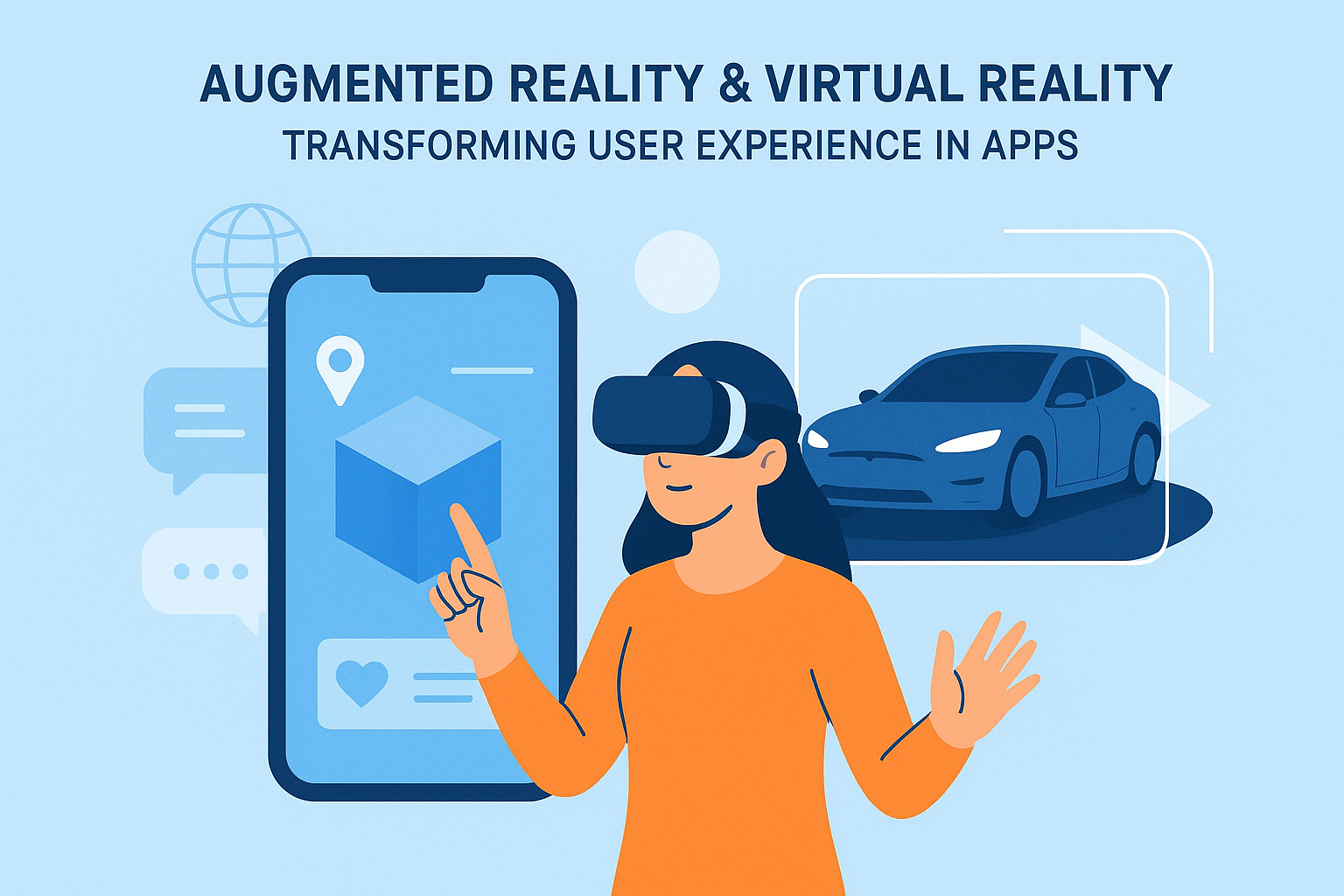
The digital era is witnessing a monumental transformation as Augmented Reality (AR) and Virtual Reality (VR) redefine the way users interact with applications. With the rise of smartphones, affordable headsets, and powerful computing, immersive technologies have shifted from novelty to necessity, influencing sectors ranging from education to healthcare.
Understanding AR and VR: The Immersive Spectrum
Virtual Reality (VR)
- Fully replaces the real world with a computer-generated environment.
- Requires headsets like Meta Quest or HTC Vive for total immersion.
- Ideal for simulations, gaming, virtual tours, and collaborative 3D environments.
Augmented Reality (AR)
- Enhances the real world by overlaying digital elements.
- Works on smartphones, tablets, or AR glasses like Microsoft HoloLens.
- Popular for navigation, shopping previews, and interactive learning experiences.
Combined Benefit
- AR and VR both aim for enhanced engagement, faster learning, and personalised experiences beyond traditional screens.
Revolutionising Industries with Immersive Tech
Retail & E-Commerce
- AR visual try-ons and VR showrooms elevate online shopping.
- Examples: IKEA Place for furniture, Nykaa’s AR makeup try-on.
- Interactive catalogues increase confidence and reduce return rates.
Education & Training
- VR enables immersive learning: medical surgeries, pilot training, industrial machinery.
- AR brings textbooks to life with 3D molecules and interactive diagrams.
- Results: Higher engagement, better retention, and practical skill-building.
Real Estate & Architecture
- VR tours enable global property viewing.
- AR overlays allow clients to see renovations or layouts in real time.
- Architects use VR to collaborate on final designs before construction.
Gaming & Entertainment
- VR gaming offers full immersion; titles like Beat Saber and Half-Life: Alyx showcase its potential.
- AR games like Pokémon GO and AR scavenger hunts combine digital fun with physical movement.
- Entertainment now includes virtual concerts, interactive storytelling, and social VR hangouts.
Healthcare & Wellness
- VR therapy for PTSD, anxiety, and pain management.
- AR for surgical overlays and real-time diagnostics.
- Virtual fitness and meditation apps provide personalised, immersive wellness routines.
Tourism & Cultural Heritage
- VR offers virtual museum tours and historical site reconstructions.
- AR enhances live tours, adding context, history, and interactive exploration.
Manufacturing & Industry 4.0
- AR assists engineers with step-by-step visual instructions.
- VR trains staff on complex machinery without risk or downtime.
- Reduces errors, improves productivity, and saves operational costs.
Logistics & Supply Chain
- AR Navigation in Warehouses: Workers locate inventory faster with heads-up displays.
- VR Route Optimisation: Simulations help improve delivery paths in challenging terrains.
- Hands-Free Operations: AR wearables enable faster and safer material handling.
Heavy Industry & Energy
- Remote Collaboration: VR connects experts across the globe for live issue resolution at plants or rigs.
- Safety Drills in VR: Workers experience realistic emergency scenarios without any real danger.
- AR Diagnostics: Energy infrastructure inspections use AR to reduce downtime and boost operational safety.
Construction & Infrastructure
- AR Project Visualisations: Real-time overlays of building plans ensure precise on-site execution.
- VR Planning & Design Reviews: Stakeholders experience projects at scale before construction.
- Worker Training & Safety Compliance: Immersive simulations reduce accidents and improve efficiency.
Agriculture & Farming
- AR Crop Monitoring: Farmers can visualise soil health, irrigation levels, and crop growth through smart glasses.
- VR Training for Equipment: Operators can practise driving tractors or harvesters in virtual fields.
- Precision Farming Analytics: AR visual dashboards optimise yield predictions and fertiliser use.
Shipping & Maritime Industry
- VR Navigation Simulators: Train captains and crews on different weather and sea conditions.
- AR Ship Maintenance: Onboard engineers receive visual overlays for repairs and inspections.
- Port Logistics Planning: VR-enabled layouts streamline cargo handling and scheduling.
Aviation & Aerospace
- VR Flight Simulations: Pilot training with realistic cockpit experiences enhances safety.
- AR Maintenance & Inspection: Technicians locate faults on aircraft faster with visual overlays.
- VR Assembly & Prototyping: Aerospace engineers collaborate on complex designs virtually before production.
- Immersive technology is reshaping industrial workflows, lowering costs, enhancing safety, and enabling smarter, data-driven operations. Companies embracing AR and VR are building the foundation for the next wave of industrial innovation.
Enhancing User Experience: The Immersive Advantage
- Increased Engagement: Interactive experiences draw repeat users.
- Better Knowledge Retention: Hands-on immersion forms stronger memory links.
- Contextual Guidance: AR overlays simplify tasks like repairs or assembly.
- Personalisation: Apps adapt content to user preferences in real time.
- Multi-Sensory Experiences: Audio-visual immersion improves emotional impact.
Technical and Design Considerations
- Performance: Optimised rendering and lightweight assets are essential for smooth AR/VR.
- UI/UX: 3D spatial design and gesture-based navigation replace flat menus.
- Accessibility: Address motion sickness and provide alternatives for users with mobility or vision limits.
- Cross-Platform Development: Target smartphones, AR glasses, VR headsets, and MR devices.
- Security & Privacy: Safeguard camera feeds, location data, and movement tracking.
Challenges and Limitations
- Hardware Cost: High-end VR remains expensive.
- Content Creation Complexity: Immersive 3D experiences demand specialised skills.
- User Comfort: Motion sickness and eye strain still impact adoption.
- Privacy Concerns: Real-world data collection requires strict security protocols.
- Battery & Performance Constraints: Mobile AR drains power quickly and needs optimisation.
Expanding Horizons: Future of Immersive Apps
- Mixed Reality (MR): Blends AR and VR for unified, shared experiences.
- 5G & Edge Computing: Enables real-time rendering and remote collaboration.
- AI-Driven Personalisation: Adaptive VR environments respond to user performance and mood.
- Spatial Computing: Creates persistent, location-based digital layers over the physical world.
- Social & Collaborative VR: Teams can co-create, meet, or learn together in shared virtual spaces.
In the next decade, AR and VR will integrate into daily apps for shopping, socialising, learning, and working—becoming as natural as using mobile apps today.
Conclusion
Augmented and Virtual Reality are more than trends—they are building the future of digital interaction. Businesses that adopt immersive design now will define tomorrow’s user expectations. With AI, 5G, and spatial computing accelerating development, the boundary between digital and physical life is set to vanish.
The next generation of applications will be immersive, intelligent, and inseparable from reality.